104 matches in 39 days: How connectivity is helping secure the FIFA World Cup 2026™


At a glance
- Verizon Frontline is collaborating with FIFA to provide mission-critical communication tools and connectivity, supporting public safety agencies and fans across 16 host cities in three nations.
- The FIFA World Cup 2026 involves 104 matches over 39 days, requiring massive logistical coordination and real-time connectivity to manage safety, security, and fan experiences.
- Connectivity acts as a vital lifeline, ensuring reliable communication for employees and providing fans with essential tools for translation, navigation, and real-time information.
The upcoming FIFA World Cup 2026™ is set to be one of, if not the largest, sporting events in history, spanning three nations and 16 host cities. To execute an event of this magnitude, the intersection of physical security, logistical precision, and digital connectivity is of utmost importance.
That’s why, for more than two years, Verizon Frontline has been collaborating with host cities to support first responders with mission-critical communications tools and capabilities they need to protect and serve their communities and fans visiting from across the world.
This level of support isn’t new for the Verizon Frontline Team. For more than three decades, Verizon has been working hand-in-hand with public safety agencies on the front lines during events ranging from massive disaster response efforts to high-profile sporting events.This includes the Verizon Frontline Crisis Response Team deploying to support public safety agencies and our partners with solutions ranging from access to the Verizon Frontline Network Slice to deployable network assets. Not surprisingly, one of the organizations Verizon has been working closely with in the buildup to the FIFA World Cup 2026™ is FIFA itself.
I sat down with Sasha Larkin, FIFA’s Director of Intelligence & C4 Operations, to discuss the Herculean effort of preparing for 104 matches in 39 days and the critical role technology plays in keeping billions of fans safe and connected.
The blueprint for global scale
Massimo Peselli: Sasha, we are approaching what is arguably the biggest sporting event in the history of humanity—the FIFA World Cup 2026™. For an event of this magnitude, what has the preparation looked like behind the scenes?
Sasha Larkin: Putting on an event across three nations and 16 cities is no easy undertaking. The FIFA World Cup 2026™ is divided into 68 functional areas, each with a specific knowledge base. Within my lane—Safety and Security—we oversee everything from intelligence and C4 operations (Command, Control, Communication, and Coordination) to accreditation and medical.
Because the geography is so vast, we’ve implemented a cross-cutting model. I manage intelligence for all 16 cities, sharing information with private stakeholders, law enforcement, and host city representatives in the U.S., Canada, and Mexico. We’ve broken the continent into geographical regions with dedicated directors to manage the “guards, gates, and guns” at stadiums and non-competition sites. It’s been years of site walkthroughs and millions of miles of walking to understand every nuance of these venues.
Massimo Peselli: Interestingly, you mentioned the scale. We are talking about a massive volume of high-profile, high-stakes matches happening almost simultaneously across a continent. How is your team mentally preparing for that kind of pressure?
Sasha Larkin: FIFA estimates over 5 billion people will watch this FIFA World Cup 2026™. Even with six million tickets available, millions more will likely travel to host cities just to be near the electricity of the event. Whether they are at the stadium, a fan festival, or waiting outside a team hotel to glimpse the world’s top players, the security perimeter extends far beyond the pitch.
The critical role of connectivity
Massimo Peselli: Communication is often the “rise or fall” of any organization. When you have 3,000 employees and millions of fans in motion, how are you ensuring the message stays consistent?
Sasha Larkin: You hit the nail on the head. Internal communication is vital—making sure every employee has a working device and clear instructions during what can be some controlled chaos. But external communication is even more complex. FIFA handles the stadium, but the host city handles everything outside. We have to be perfectly synced.
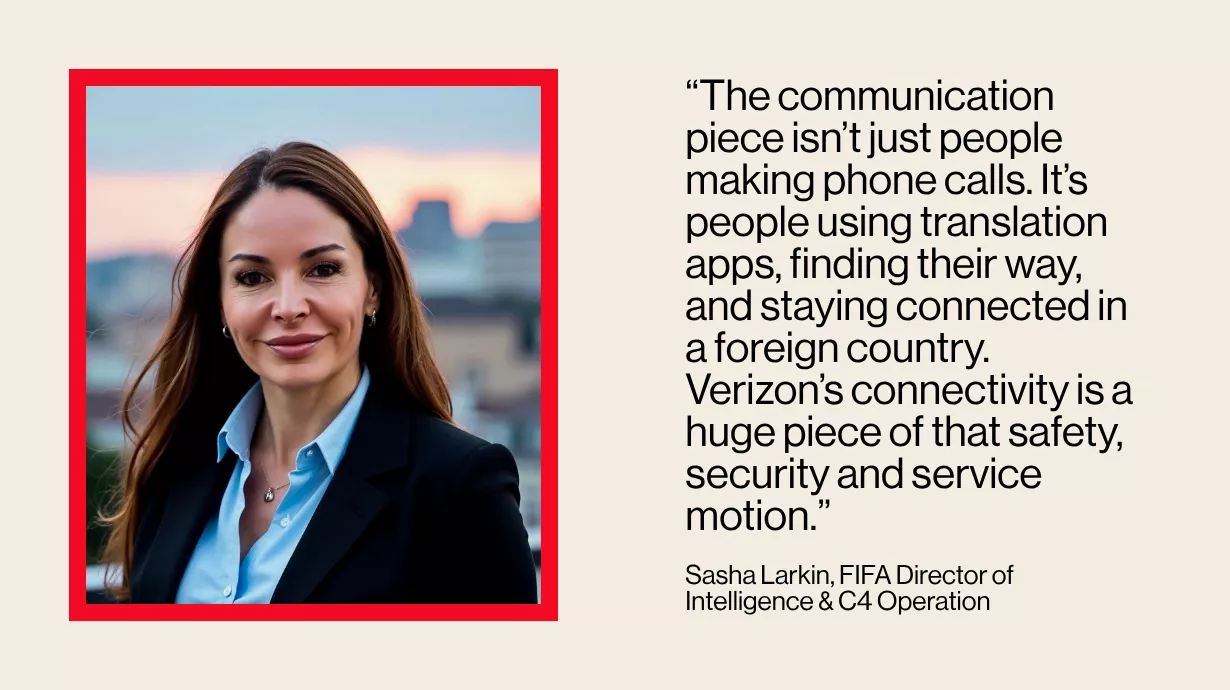
This is where the network becomes a lifeline. Think about the fans: we have 48 countries represented and dozens of languages. Fans rely on their phones for everything—translation apps to navigate, ride-sharing services to get home, and wayfinding apps to find their gates. If the network fails, the fan experience—and potentially their safety could be compromised.
Massimo Peselli: That is exactly why Verizon is working so hard with public safety organizations and FIFA. We are working to enhance the connectivity and Wi-Fi inside the venues and to support infrastructure in host cities. We want to help enable a reliable, prioritized platform for public safety, while fans have the bandwidth to share their experience in near real-time. In your experience, how paramount is that “always-on” connectivity?
Sasha Larkin: It’s everything. I learned a lesson as an incident commander during large-scale emergency incidents: when 100,000 people ask a voice assistant for the nearest hospital at the same time, the network has to be able to handle that load. Connectivity is the most important tool a fan has in their palm. What Verizon is doing is a massive piece of the safety puzzle.
A legacy of unity
Massimo Peselli: We are incredibly proud of this partnership. We’re working to make sure that whether you’re a first responder or a fan, the communication network allows you to focus on the event itself. Sasha, any closing thoughts as we head toward kickoff?
Sasha Larkin: Our goal is that whether you attend a game in Toronto, Kansas City, or Guadalajara, you have the same top-notch experience in safety, security and service.
But beyond the logistics, there’s a cultural legacy here. Soccer unites the world. At a time when global divides can feel quite large, we have an event that brings people together through pure passion. We want the takeaway to be that unity.
Massimo Peselli: Thank you, Sasha, for everything you and FIFA are doing to keep this event safe.
About the author
Massimo Peselli
Massimo Peselli is the Senior Vice President and Chief Revenue Officer, Global Enterprise and Public Sector for Verizon Business. He leads a global team focused on delivering innovative technologies like 5G, mobile edge computing (MEC), cloud, security, and software-defined networking, to enable enterprise and public sector clients to win in the marketplace today while laying the groundwork for their digital transformation journeys.
Categories: