Policing on the global stage: How Philadelphia is preparing for FIFA World Cup 2026™


At a glance
In 2026, the eyes of the world will turn to Philadelphia. While several North American cities are hosting FIFA World Cup 2026 ™ matches, the City of Brotherly Love stands alone in its magnitude of commitment. Not only will the city host six high-stakes matches, including a historic game on the Fourth of July during the nation’s 250th anniversary, but it is the only city hosting a 39-day Fan Festival that VBG will run throughout the tournament.
I recently connected with Philadelphia Police Commissioner Kevin Bethel to discuss the “Six Ps” of planning, the technological “highways” keeping first responders connected, and why every visitor is a vital partner in public safety.
The magnitude of the moment
Massimo Peselli: Commissioner, Philadelphia is in a unique position. You’re hosting six games, but you’re also the only city running a Fan Festival for 39 consecutive days. On top of that, you have a game on July 4th—our nation’s 250th birthday. How does the Department even begin to wrap its head around that kind of pressure?
Commissioner Kevin Bethel: It’s a massive undertaking, but we have the muscle for it. Philadelphia has a long history of managing large-scale events—the Pope’s visit, the RNC, Super Bowl parades. We know how to do this. I tell my team there are “Six Ps” to remember: Prior Proper Planning Prevents Poor Performance. I learned that as a young sergeant in narcotics, and it’s the foundation of our 2026 strategy.
We aren’t just planning for 90 minutes of soccer; we’re planning for a six-week grind. We have the FIFA World Cup 2026 ™ match at 5:00 PM, the Fan Festival running concurrently with it, and the Welcome America nighttime celebrations all happening at once.
The connectivity foundation
Massimo Peselli: At Verizon, we talk about connectivity as the “invisible backbone” of an event. In addition to the in-venue connectivity and the increased capacity across the city, our Verizon Frontline Crisis Response Team will be working with first responders to provide access to the Verizon Frontline Network Slice to help enable public safety with a dedicated “highway” for data, even when 500,000 fans are trying to upload videos at the same time. How critical is that digital infrastructure to your command and control?
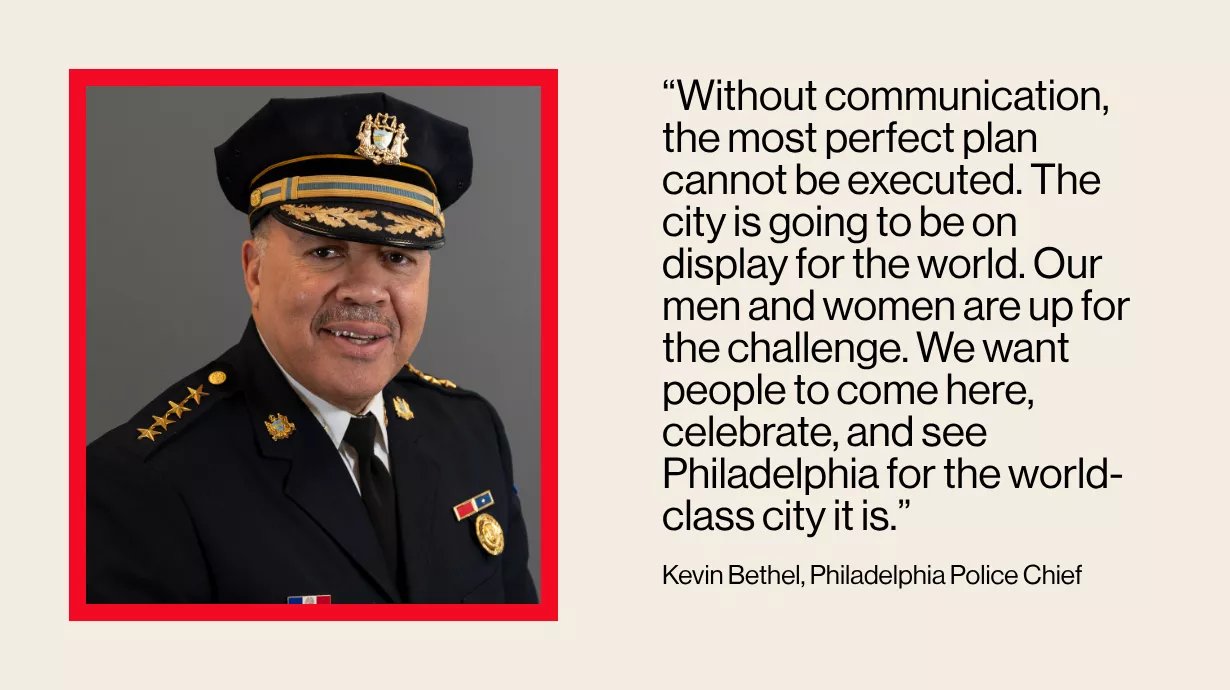
Commissioner Bethel: It is the foundation of the entire operation. Without communication, the most perfect plan cannot be executed. While we use 800 MHz radios, a huge portion of our connectivity—and the connectivity of our federal and state partners—relies on cell service and landlines.
If our officers can’t talk to each other, or if the public can’t reach us, we’re behind the curve. This is why the infrastructure work you’re doing is so vital. We need a system that is synced and seamless across all 134 square miles of this city.
A multi-layered defense
Massimo Peselli: You mentioned federal and state partners. How does the collaboration work when you have the heads of State Police and local PD all in the mix?
Commissioner Bethel: We recognize we can’t do this alone. We’re working with the Office of Emergency Management (OEM) and our federal partners to bring in everything from bomb-sniffing dogs to intelligence support. We’ll have nearly 400 State Troopers moving into the city.
We’ll also have multiple command centers active:
The “force multiplier” strategy
Massimo Peselli: Beyond the uniforms, you’ve spoken about the public’s role in safety. What is your message to the residents and visitors who will be in Philly in 2026?
Commissioner Bethel: I want the public to feel like they are part of the team. We often use the slogan “See something, say something,” but we need to reinvigorate that. We need the public to be a force multiplier. Nothing is more powerful than a million people who have their heads up, watching out for one another. Whether it’s using our Access Philly 2026 app to stay informed or calling 911 when something doesn’t feel right, we need that partnership. We’re even launching a specific “blitz” and dedicated lines to combat human trafficking, educating hotel operators and neighbors on what to look for.
The long game
Massimo Peselli: 39 days is a marathon, not a sprint. How are you addressing officer fatigue?
Commissioner Bethel: There’s no question it will be a grind. We’ve been talking to our men and women about this for two years. We’ve adjusted staffing models to ensure we have the numbers, but we’re also working with the courts and our special operations team to build in relief where we can.
The city is going to be on display for the world. Our men and women are up for the challenge. We want people to come here, celebrate, and see Philadelphia for the world-class city it is.
About the author
Massimo Peselli
Massimo Peselli is the Senior Vice President and Chief Revenue Officer, Global Enterprise and Public Sector for Verizon Business. He leads a global team focused on delivering innovative technologies like 5G, mobile edge computing (MEC), cloud, security, and software-defined networking, to enable enterprise and public sector clients to win in the marketplace today while laying the groundwork for their digital transformation journeys.
Categories: