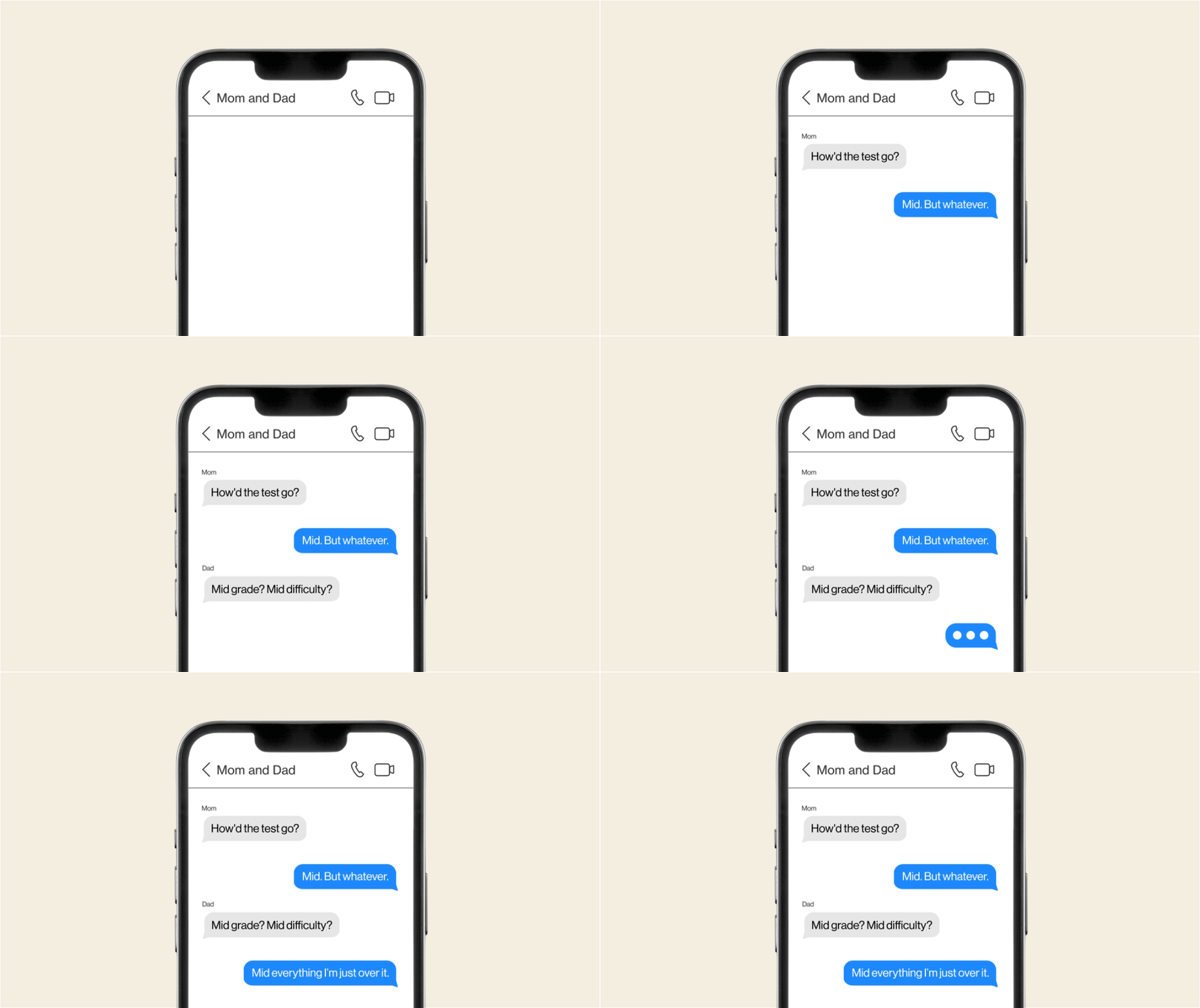
Dry texting: The meaning behind teens’ short texts
Dry texting’s low-effort messages aren’t always a brush-off. For teens, research shows these short texts are often a way to manage the mental load and still stay engaged.

You spend five chaotic minutes crafting the perfect text to your tween. It’s short. Thoughtful. Not too cringey.
The reply?
“kk”
There’s a term for this kind of ultra-short response: dry texting. And while these responses can feel like a brush-off, researchers say they’re usually something else entirely.
It’s often simply a way to say, “I’m here, but I can’t talk right now.” For parents, understanding the slang and shorthand can help, but what’s at stake isn’t manners or grammar. Early adolescence is when kids are learning how to handle relationships, conflict and complicated emotions. Short texts can also offer clues about how they’re managing all of it.
To better understand what dry texting means for teens, we spoke with Mary Chayko, Ph.D., sociologist and Distinguished Teaching Professor at Rutgers University’s School of Communication and Information, and other researchers who study how technology is changing the way we talk and text.
How does dry texting help teens and communication?
From a sociological perspective, dry texting is often about managing limits. Short replies can function as:
- A signal of limited emotional bandwidth
- A boundary that says, “I’m here, but I can’t get into this right now”
- A stylistic choice: It’s just how their friend group talks
Chayko’s research on digital communication shows that dry texting emerged because constant connection made quick responses necessary.
Kaylin Peete, Program Specialist at the Family Online Safety Institute, agrees. And she says that dry texting has taken off as the push toward efficient communication has intensified in recent years.
“That cultural shift came with generative AI,” she explains. “Kids are getting used to technology making things faster: instant answers, instant help. That expectation shows up in texting, too.” Because adults tend to read tone and intent differently, Peete says, these digital responses are often misunderstood.


Are short text messages really a problem?
This is where Sherry Turkle, Ph.D., Founding Director of the MIT Initiative on Technology and Self draws an important distinction.
“The problem is not dry texts,” Turkle says. “The problem is substituting texting for talking. Don’t allow texting to be part of a flight from conversation in your family.”
Naomi Baron, Ph.D., a linguist at American University, who studies how digital technology shapes communication, agrees.
“We are losing the ability to read people,” Baron says. “Knowing how to say something that’s appropriate—or if you say something inappropriate, knowing how to recover—is something you really learn in person.”
Does dry texting impact real-life social skills?
Research scientist Chelsea Olson, Ph.D., who studies social media and adolescent health at the University of Wisconsin-Madison, says that while texting removes facial cues and tone, it doesn’t mean teens are losing the ability to read those non-verbal signals. Most still experience them daily, at school, at work and in games.
“Texting is a less-rich form of communication,” Olson says, “but it doesn’t replace all the other ways teens are interacting.”
So when does dry texting become something parents should be concerned about?
“Each child is different,” Olson says. “If short texts are just how they communicate, that’s not a problem. But if a teen suddenly withdraws, online and offline, that’s when it’s worth paying attention.”
Basically, parents shouldn’t overreact if:
- Short replies happen during busy parts of the day.
- Your child is warm and connected in other moments.
- This is how your child texts everyone.
At the same time, it’s important for parents to recognize signs of a possible problem, such as:
- Dry texting happens only during conflict, with no attempt to talk or repair later
- Your child avoids conversations both online and offline
- You notice other changes in mood, sleep, school or friendships
How parents can step in without adding stress
Baron suggests starting with a simple but often overlooked question to your teens: How do you like to communicate?
“How soon would you ideally respond? How long would your response be? What feels respectful to you?”
Parents can model that clarity, too. For example:
- Use text for logistics, not big emotions.
- Save harder conversations for face-to-face moments.
- Say, “We can talk about this later,” and follow through.
From dry text to haiku
For many teens, a one-word text isn’t an ending.
The short structure lends itself to a haiku format, Turkle says. “Yes. No. Busy. Love. Safe landed.”
It’s not always a dismissal, and it’s not always a problem to solve in the moment. Sometimes the most supportive response leaves room to talk later.
Quick reply received
I’ll save the big stuff for later
Love you, carry on
We got you: You’re there for them with Verizon Family. Verizon’s there for you—including our 3-year price lock.*
*Learn more about our 3-year price lock guarantee.