A race car sweeps through a corner at 200 mph (320 kmh) and the telemetry feed cuts out. For two full minutes, the pit can't tell if something on the car is about to fail. "We were flying blind," says Jordan Krell, Connectivity Engineer, Bosch Motorsport. "You have no information on the car. That's not acceptable."
Bosch is a leading global supplier of technology and services, building everything from home appliances to the components inside modern cars. It has been in racing for more than a century because the track is where it proves its technology works under the most extreme conditions — and what survives there makes its way to the road.
Today, Bosch Motorsport supplies the sensor, telemetry, integrated software, safety and control systems professional racing series worldwide depend on, and it builds them so the data feed never goes dark. Everything Bosch Motorsport builds moves data from the cars to the people who need it.
A car's data feed has grown from a handful of basic readings — Are the tires up? Is the engine running? — into a live stream that informs engineering decisions in real time. Strategy once made on intuition now runs on near real-time analysis.
"They're kind of like us," Krell said of the cars. "They don't leave home without a cell phone to start with."
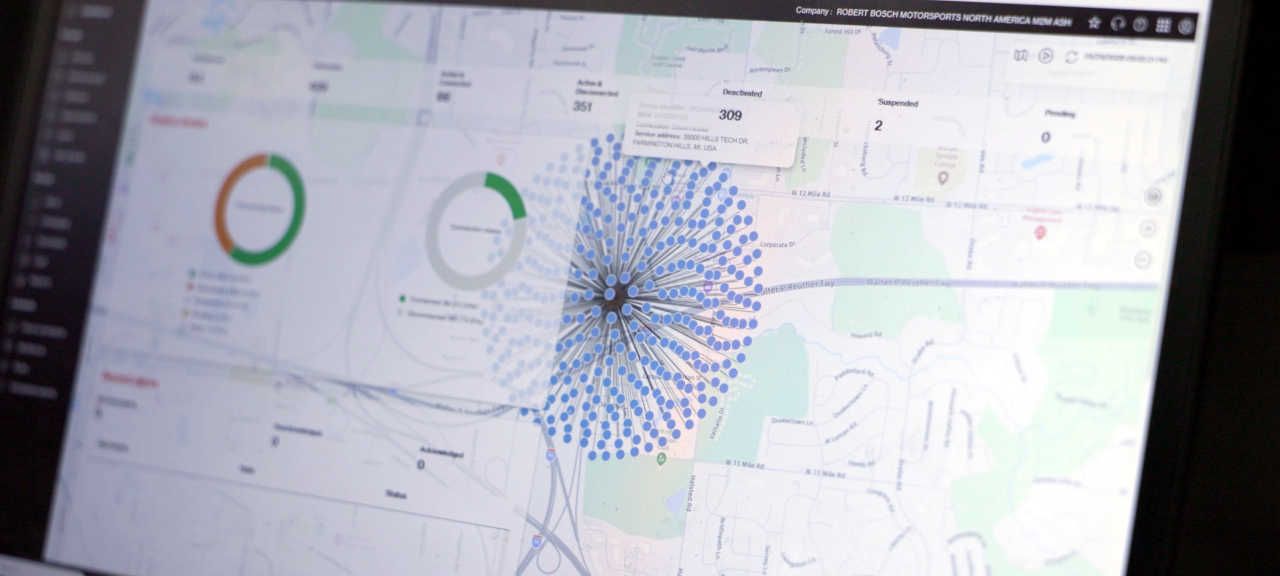
That data, transmitted through the Connectivity Gateway 3.2 (CG 3.2) modem, then flows through RaceConnect, Bosch's flagship software-as-a-service (SaaS) platform. RaceConnect distributes the data to race officials enforcing rules and safety, as well as to teams competing to win.
RaceConnect ensures every customer receives their data at the racetrack and anywhere else it is needed, at their factory or even at their kitchen table. For teams and series that operate globally ease of use is critical. That meant replacing three regional device fleets with a single world device, and Bosch built it with Verizon Global IoT Orchestration.

Crowded airwaves, packed grandstands and region-locked hardware
"We're kind of a traveling circus that all shows up in one very small area," Krell said. "And every race trailer, every team is like a small office building with its own networks." All those competing signals make it hard to get reliable data off a fast-moving car.
That task becomes exponentially more difficult on race day. When crowds fill the grandstands, their phones flood the public network, and the data the series and the teams rely on risks being drowned out when it matters most.
For years, Bosch also built and managed separate devices for North America, Europe and Asia-Pacific. When a car raced outside its region, someone had to swap in the right unit, and a busy crew could easily grab the wrong one. The extra work strained the team and limited how quickly Bosch could grow in the market.
Bosch aimed to mirror the U.S. solution for racetracks around the world and never swap hardware again. Bosch and Verizon set out to resolve this challenge together.
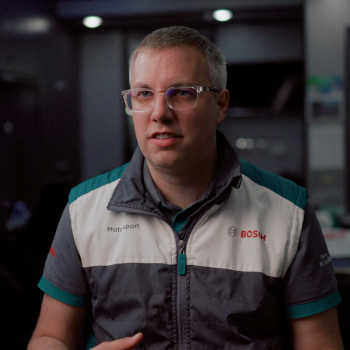
Global IoT Orchestration enables Bosch Motorsport to scale our RaceConnect solution globally, keeping us in the fast lane of race technology and speeding up our time to market.
Jordan Krell, Connectivity Engineer, Bosch Motorsport
A private wireless network solution lays the groundwork for automation
In the U.S., Verizon's engineers had already worked with Bosch to keep connectivity continuous, delivering secure, timely data feeds race after race. Verizon then packaged that formula and customized it for the rest of the world with Global IoT Orchestration.
Bosch and Verizon's engineers meet weekly, and Bosch can tap into Verizon's local network teams even in markets it only visits once a year. Krell spends race weekends at the circuit analyzing network data in real time, watching how each car's radio performs. "That is our biggest secret sauce in working with Verizon," he said.
Under Global IoT Orchestration, Bosch now builds a single module for global application, the new cellular gateway, CG 3.2, at its plant in Germany. It supports 4G and 5G in both non-standalone (NSA) and will soon be able to support standalone (SA) modes. Bosch’s CG 3.2 is factory-installed with a Verizon eSIM profile, and remotely switched to a partner mobile network operator's (MNO) eSIM profile for non-US deployments, without manual intervention. Bosch pre-configures connectivity into each device when a customer orders from another country, so it ships ready to connect.
Remote SIM provisioning, built on the GSMA remote SIM provisioning specification, makes that possible by swapping carrier profiles over the air. “It allows us to do manufacturing in one location and have the peace of mind that whenever a device shows up to a customer, it will work exactly as they expect and be plug and play,” Krell explained.
The Global IoT Orchestration solution also puts Bosch’s devices on in-market partner networks — the mobile MNO's in each country — this provides maximum coverage available for the country with more than one MNO. Krell pointed out that running on regional MNO’s core network gives Bosch the best performance all around the world, without routing all race traffic back to the US network for international races.
Verizon carves out a private lane for race data
Krell holds every deployment to three non-negotiables: “It has to connect every time, the data has to get end to end, and it has to be secure when we do so,” he said.
A mobile private network (MPN) delivers on all three criteria. Race telemetry gets its own private and secured lane, segregated from the fan traffic that swamps the public network, so Bosch’s data never fights a grandstand full of phones. In the U.S., that lane runs on Verizon’s MPN. Abroad, Verizon’s mobile network partner’s core network operates an MPN of its own.
“Having an MPN is critical to Bosch mainly for security reasons,” said Andy Diffenderfer, Associate Director, Verizon.
Where MPNs logically separate Bosch's traffic from other users across carrier networks, a unified custom private access point name (APN) keeps data completely isolated. The APN is the configured on-ramp each device uses to reach the MPN, and one unified private APN serves every Bosch device everywhere. Whether a device runs a Verizon eSIM profile in the U.S. or a partner eSIM profile abroad, it behaves identically across networks.
Additionally, Verizon plans to add a 5G network slice in the US to prioritize Bosch's traffic. "What the 5G slicing will allow us to do is have that reserved space for our devices, so we can bring an additional level of reliability and priority over what we already have with Verizon,” said Robert Webster, Motorsport Software Engineer, Bosch Motorsport.
Bosch’s engineers made a significant breakthrough: the cloud infrastructure and the device needed a handshake. Once the team optimized how the two completed that handshake, coverage increased around more of the tracks.
"We really took our learnings we had here with Verizon and implemented them all around the world", Krell said.
Bosch manages every device through ThingSpace
Once hardware starts shipping worldwide, Bosch manages and scales it all through ThingSpace, Verizon’s connectivity management platform. The team sees every device and changes settings for a single device or a batch of 100 at a time, directly or through the platform’s APIs.
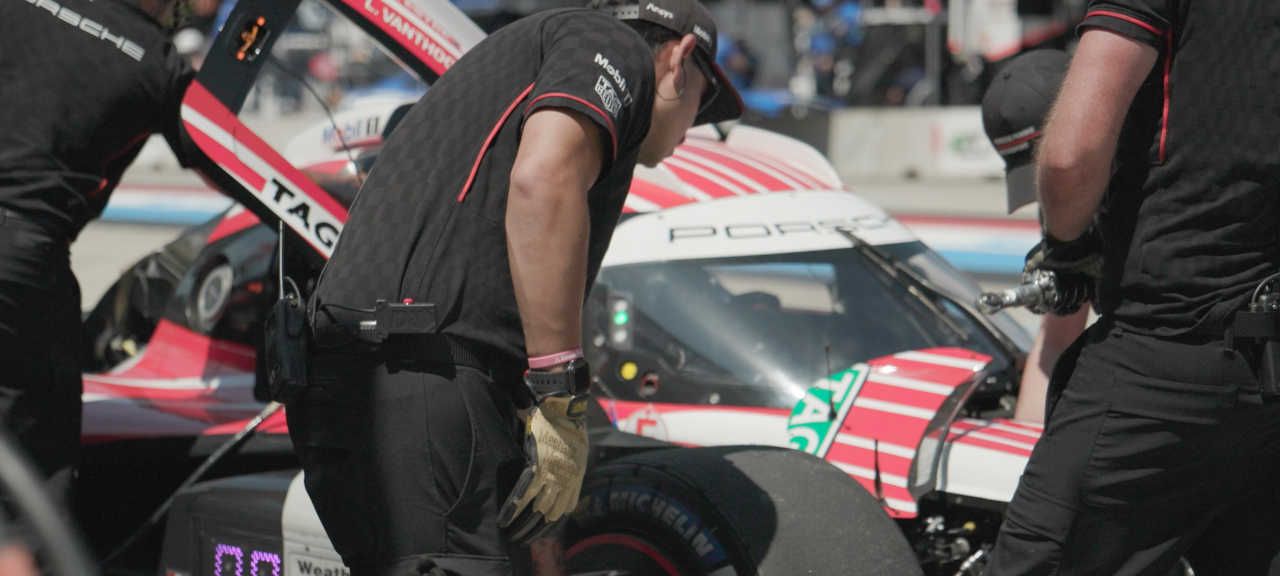
In the U.S., ThingSpace’s wireless management tools add one-click fleet control, and the 2026 Detroit Grand Prix put that U.S. capability on display. Because the circuit hugs the river across from Canada, ThingSpace allowed Bosch to instantly manage profile settings across its entire U.S. fleet with a single click to prevent accidental cross-border connections.
ThingSpace’s APIs also feed into RaceConnect. A customer selects a new region and about seven calls fire behind the scenes to reconfigure the service. The customer clicks once, and Bosch gets a notification when it’s done — all of it in one place so the data never stops.
With that integration, Bosch operates as a global SaaS provider rather than a hardware maker alone: customers subscribe to RaceConnect, and the Verizon connectivity behind it comes built in.
Data everyone at the track can count on
Teams build race strategy on telemetry they can trust and act on from the pit. Officials read the same stream to confirm the field competes fairly and safely. And low latency is the baseline safety requirement, because everyone involved needs to know about a developing issue the moment it happens.
Webster still thinks about the first big race of the season where Bosch deployed the solution, and the experience of delivering reliable data across the whole event. “It’s a big accomplishment. It’s something that we all feel really good about,” he said.
The same solution simplified Bosch’s operations. One device now replaces the regional fleet, remote provisioning ends the hardware swaps and once-disjointed systems feed a single source of entry for data on the cloud infrastructure.
Bosch and Verizon put a new business line on track
Bosch has just started sending the first devices out the door. Bosch and Verizon plan to grow the pipeline of international deployments. "We'll look to more use cases and look to work with Bosch in more divisions," Diffenderfer said.
Meanwhile, Krell wants to move even more data off the car. Bosch is exploring the vehicle as a connectivity and gateway hub and weighing whether edge computing could run onboard.
Jacob Bergenske, Director, Bosch Motorsport, already sees where the work leads. “We are leveraging the foundation and knowledge we have to continuously build together,” he said. “We’re going beyond the continental 48—and that’s what’s exciting to us, because at the end of the day, racing is an international business. And so is data.”
We really took our learnings we had here with Verizon and implemented them all around the world.
Jordan Krell, Connectivity Engineer, Bosch Motorsport.