Fifty-six cars lined up to race across 244 miles of rugged, dusty roads from Nice to Salon, France, and back on March 25, 1901. A Mercedes, fitted with a Bosch magneto ignition, won the competition.
That victory launched a winning streak that has carried Bosch onto the grid ever since.
“Our company, from the very onset, saw racing as an opportunity to showcase our technology and prove that it’s robust under the most extreme conditions,” said Jacob Bergenske, Director, Bosch Motorsport. “Fast forward to today and we’re doing the same thing, with obviously much more advanced technology but very similar fundamentals.”
Over the next century, Bosch used those grueling race conditions to refine everything from spark plugs to entire ignition systems before bringing them to everyday passenger cars. Though, what the sport demands now has changed. A century ago, the hard problem was keeping an engine running. Today, it’s keeping data moving.
Those cars now stream hundreds of channels of telemetry at more than 200 mph (320 kph), feeding engineers who have fractions of a second to act on it. To keep that data flowing, Bosch turned to Verizon.

Bosch’s race cars outgrew the old way to move data
When Bergenske began his career in motorsport more than 19 years ago, a team pulled data off a car using dedicated systems in their own frequency space. That approach carried Bosch a long way, but implementation became complicated as racing globalized. Eventually, each crew had to lean on a patchwork of legacy wireless technology, proprietary UHF and unlicensed frequencies just to get the data off the car. Complicating matters further, every track was a fresh puzzle of interference and manual setup.
Stephen Priestman, Systems Support Engineer for Paul Miller Racing, is intimately familiar with these challenges. His team streams 400 data channels off its BMW M4 GT3, some refreshing 10 times a second, far more than radio could ever carry. “The best way to describe the radio is like being in a disco and you’re standing next to the speaker,” he said of the UHF interference his team used to fight.
The problem compounded at scale. When a race weekend drew enormous crowds — as many as 180,000 fans at a track like Daytona International Speedway — all those phones turned the public network into a wall of noise. Critical race data could no longer reliably get through. Engineers risked losing the live readouts they count on in the moments that decide a race.
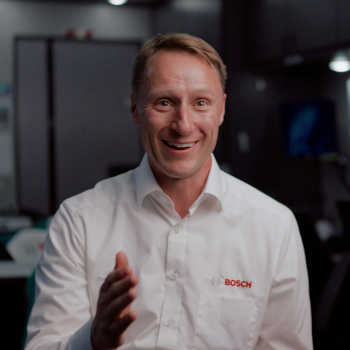
You cannot get the results that we have achieved without the collaboration between Bosch and Verizon.
Jacob Bergenske, Director, Bosch Motorsport
Bosch gains an engineering collaborator, not just a network
Verizon paired a private, secured lane for race data with a team of engineers who treated Bosch’s problem as their own.
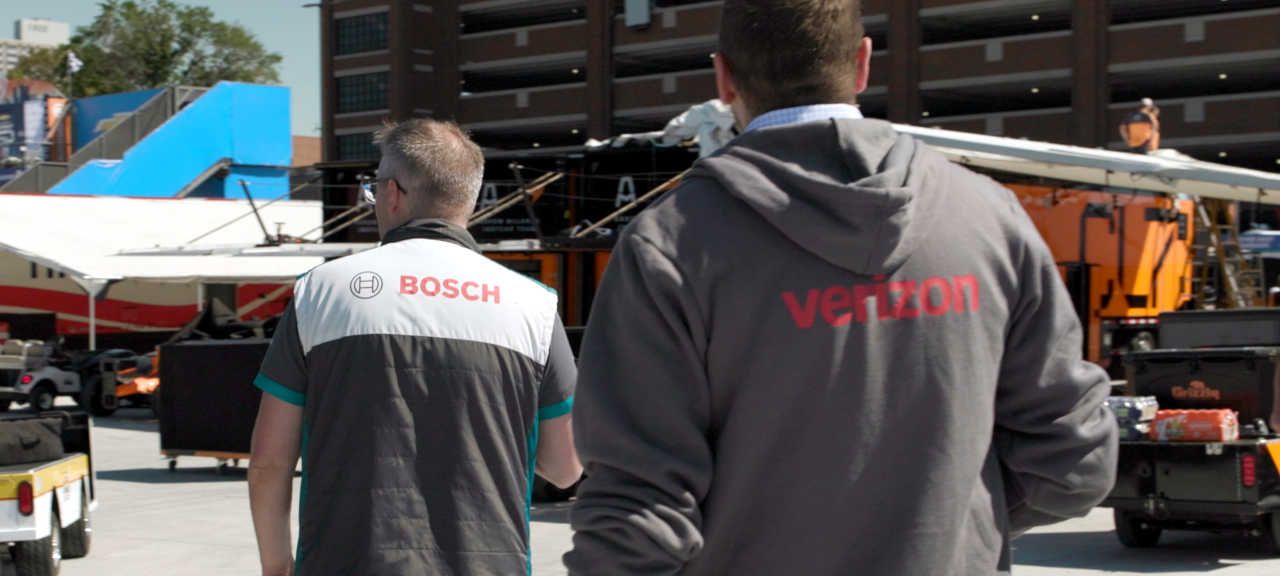
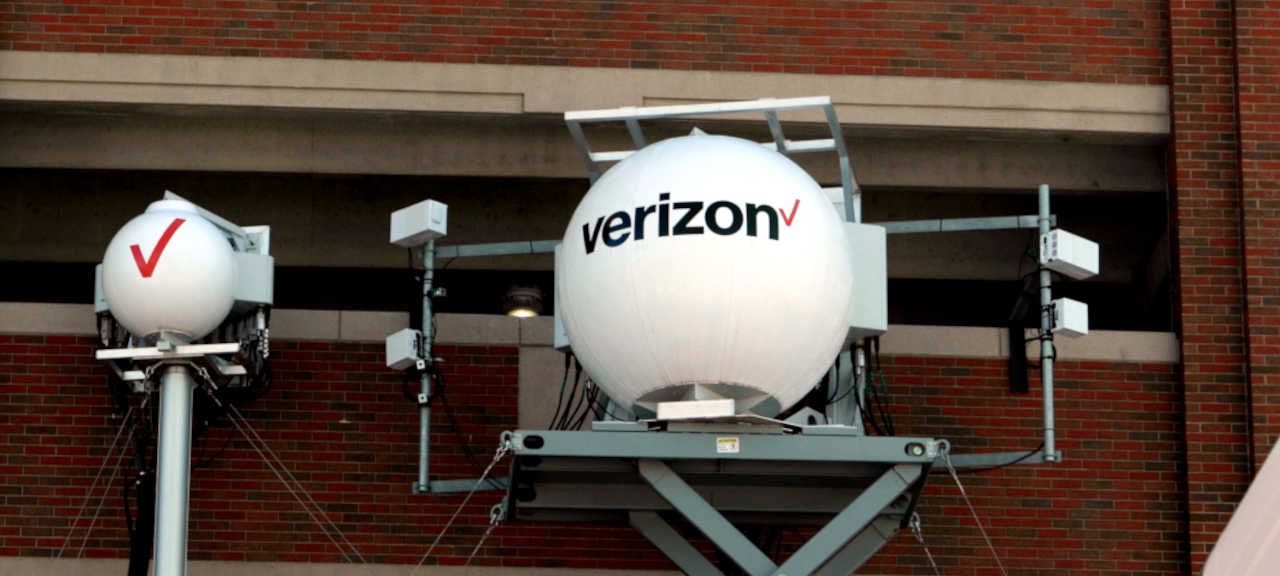
At each race, Verizon sets up infrastructure built for the conditions, from small cells and distributed antenna systems to Cells on Wheels and Cells on Light Trucks, all positioned for trackside coverage and engineered for a smooth handoff even at racing speed. Race telemetry rides a mobile private network, walled off from the public traffic so it never competes with a stadium full of fans.
“Verizon’s powerful network and Bosch’s race technology, knowledge and leadership are coming together to create a solution that, quite frankly, is difficult to replicate because of the strength of the collaboration and the people behind it,” said Andy Diffenderfer, Associate Director at Verizon.
Asked to name the single capability that makes it work, he said, “It’s the people. The amount of engineering support we bring to the table allows Bosch to do what they do best.”
That close collaboration proved essential when troubleshooting cross-border communications. The Detroit Street Circuit runs along the city's riverfront directly across Canada, and data devices can accidentally drift onto foreign mobile networks. Solving this wireless crossover required technical teams on both sides of the border to work in close concert.
“We actually had teamwork and a lot of back and forth,” Bergenske said. “We’d say, ‘This is what we’re seeing. Here’s the data,’ then they’d look on their side and we’d optimize that situation. Without that collaboration, you’re not getting the fundamental connectivity to start with.”
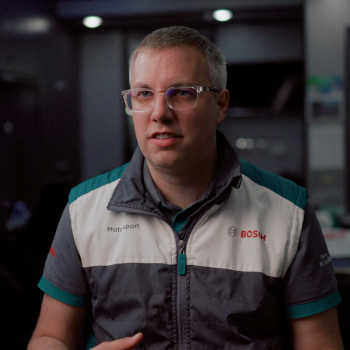
Working with people who are experts in their field is priceless assistance that you can only get by having a relationship with a company like Verizon.
Jordan Krell, Connectivity Engineer, Bosch Motorsport
Race teams turn live data into faster decisions
The race teams running Bosch’s systems soon noticed significant network performance improvements. Where a spotty connection once cut out across long stretches of a circuit, the private network now held across the whole track. “We’d have dropouts. You’d lose like a third of the track,” Priestman said. “Now we have 100% wherever we go.” That steadiness is the floor everything else stands on.
Reliable network performance also supports Bosch’s mandate to help ensure maximum safety. “At the end of the day, safety is priority zero,” Bergenske said. “If the vehicle is not safe, if the systems aren’t safe, we aren’t racing.” That’s why low latency isn’t a performance luxury — it’s a safety requirement. Reliable real-time telemetry lets a team catch a temperature creeping up or a system starting to fail in the moment it happens, not a lap too late.
Engineers read that same live telemetry to decide how a race is won, adjusting the car on the fly and leaning on the data for the calls that settle an afternoon. “Obviously they need the data in real time to determine those decisions, all the way up until the last corner before they go into the box,” Bergenske said of the split-second choices around pit stops and tire selection.
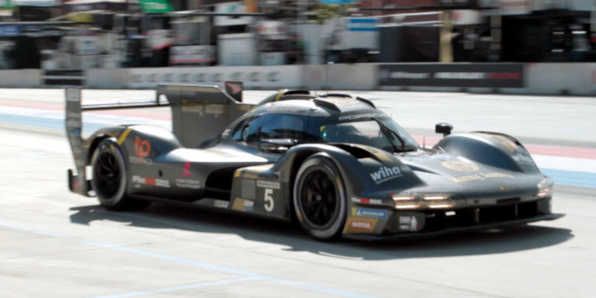
John Church, Managing Partner for JDC Miller Motorsports, runs a Porsche 963 hypercar in the GTP class, where the margins between teams are vanishingly small. “Making changes throughout the race adds up to sometimes tenths of a second per lap, which is huge,” he said. Those real-time tweaks feed directly into podium finishes.
Beyond the live adjustments, Church and his engineers lean on the same stream of data to spot trouble while they still have time to act on it. “You could either see the train coming at you, or you can wait for it,” he said. Knowing what’s coming lets a team react in time if a problem arises—or simply race with peace of mind if all is clear.
One device, every track, anywhere in the world
Bosch wanted to take what it had perfected in North America and scale it worldwide. That initiative quickly surfaced the last and hardest barrier: hardware. A global operation used to mean building different devices for different regions, then managing each one separately. That fragmentation strained the team and capped growth.
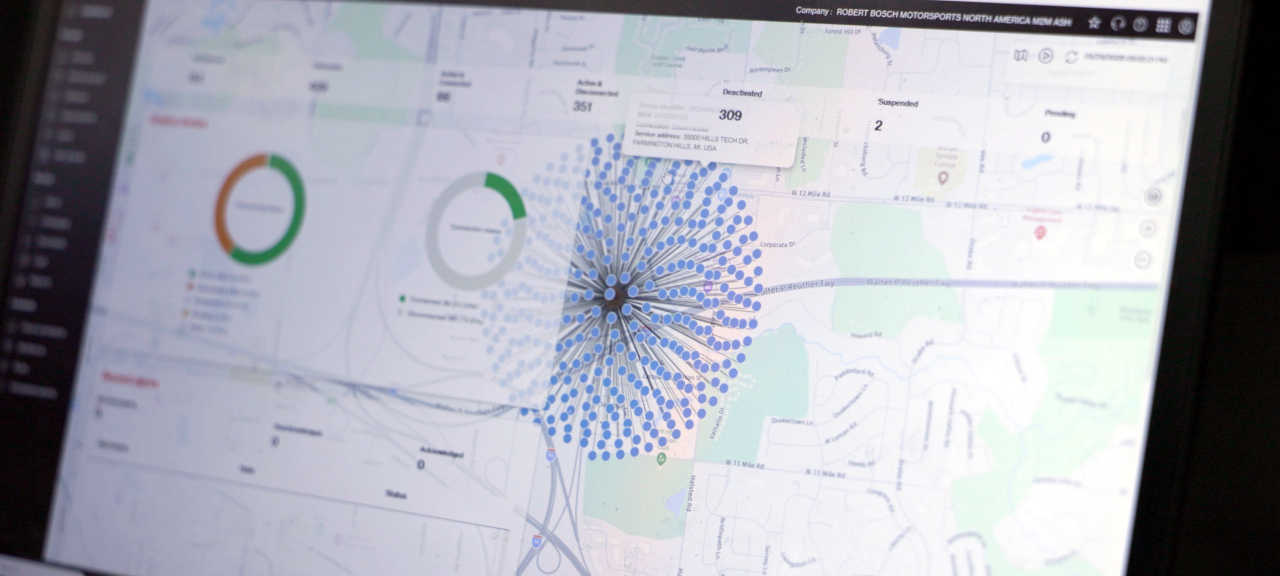
Verizon’s Global IoT Orchestration overcame these obstacles. At its core is a single custom private APN—the Access Point Name that tells a device how to reach the network. Where a global product might once have needed a separate gateway and setup for each country, Bosch hardware now ships from the factory carrying just one, ready to reach a secured global network. The solution lets IoT OEMs access more than 146 markets worldwide.
Bosch now manages it all through one US-based relationship with Verizon, instead of separate carrier contracts in every market. With Global IoT Orchestration, Bosch’s devices will have access to multi-carrier markets to ensure maximum race connectivity coverage with regional performance.
That means a single module bound for Detroit or Tokyo ships with the same configuration and connects the moment it lands, freeing Bosch’s engineers to focus on guaranteeing a smooth race rather than wrangling connectivity.
Bosch and Verizon take their collaboration global
Verizon and Bosch are already scaling this model into other areas of Bosch’s global business, bringing the same orchestration approach to new divisions and use cases. For a company that has proven its technology at the edge of what’s possible since 1901, the next chapter looks a lot like the first—only now the breakthroughs travel at the speed of data.
Through it all, from a spotty trackside signal to a network that follows the cars around the world, a close collaboration has made these steady advancements possible. “You cannot get the results that we have achieved without the collaboration between Bosch and Verizon,” Bergenske said.
We're experts on how race cars work, and we want to work with the experts who are experts in networks. That is our biggest secret sauce in working with Verizon.
Jordan Krell, Connectivity Engineer, Bosch Motorsport
Learn more
Global IoT success story
See how Bosch scaled their racing telemetry globally with Verizon Global IoT Orchestration.
Verizon ThingSpace
See how multinational U.S. enterprises can streamline global IoT connectivity.
Customer success story
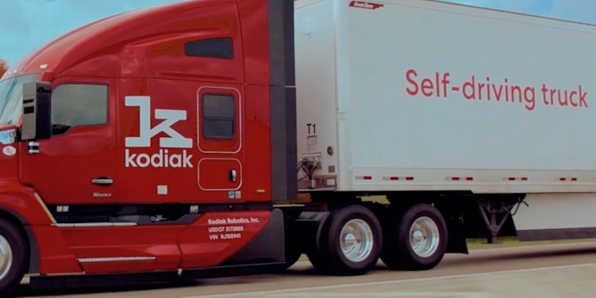
Hear how Kodiak scales human-AI collaboration through Verizon IoT connectivity.