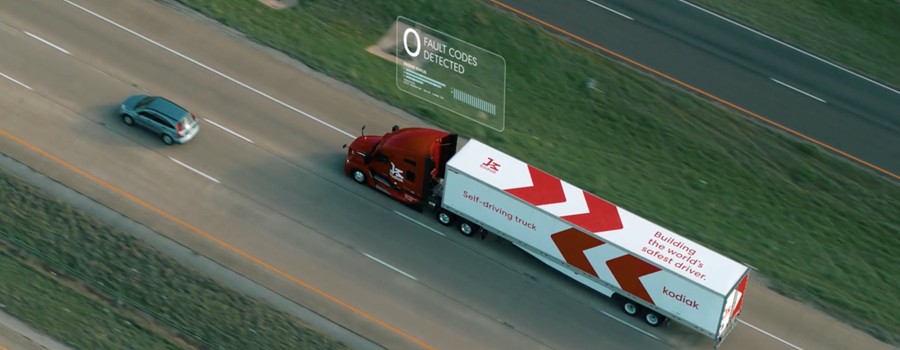
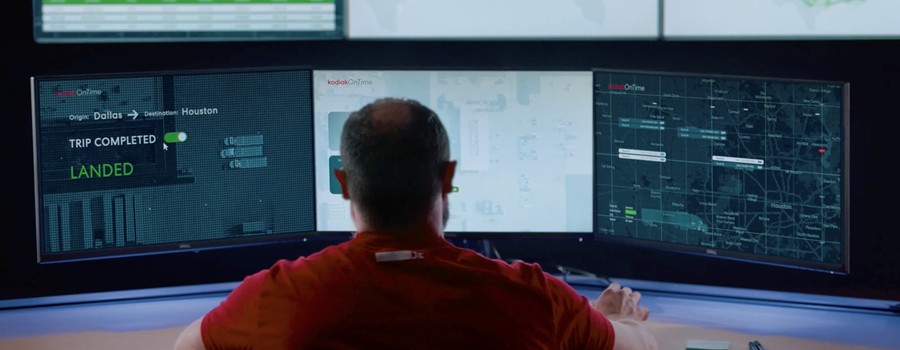
A notification flashes across screens in Kodiak AI’s Dallas operations center, signaling the need for human assistance. Nearly 500 miles away, an autonomous truck carrying tons of frac sand has encountered something its artificial intelligence (AI) has rarely seen: construction equipment is blocking the road.
A remote operator quickly reviews the vehicle’s camera feeds, assesses the situation and helps guide the truck around the obstacle. The entire interaction takes less than a minute. The truck continues its route in driverless operations. It’s a routine moment that represents something revolutionary.
Kodiak provides autonomous driving as a service to customers across three markets with two distinct operating models: fully autonomous industrial operations where trucks operate 24/7 without drivers in remote locations, over-the-road trucking with partners like Werner and J.B. Hunt, where human drivers remain in the cab for now, and defense initiatives supporting national security objectives.
"Our business model is providing autonomous driver-as-a-service on a 24/7 basis," explained Michael Wiesinger, Kodiak’s Chief Operating Officer.
But bringing this vision from concept to commercial reality, with trucks operating autonomously in some of America’s most remote industrial locations, required the company to solve new connectivity challenges.

Driver shortage creates safety and operational risks
America’s trucking industry faces an acute driver shortage, particularly for long-haul routes that keep drivers away from families for weeks. In remote industrial operations sites, where workers fly in for extended shifts, companies face even steeper recruiting challenges. Safety is also a significant concern. In 2023, large truck crashes led to 5,375 deaths in the U.S., according to the National Safety Council. Human error is responsible for more than 85% of truck crashes in the U.S.
Kodiak's driverless solution faced a challenge. Kodiak needed reliable connections for trucks operating 24/7 in locations where traditional infrastructure didn't exist. Initially, the company struggled to find the required connectivity. Before partnering with Verizon, Kodiak had to juggle multiple carriers, each with inconsistent portals and unreliable APIs.
As trucks moved between highways and industrial sites, maintaining seamless connections across different network environments added another layer of complexity. These technical challenges would have been daunting on their own, but there were even more imposing roadblocks ahead.
Kodiak's proprietary Assisted Autonomy model relies on ultra-reliable, low-latency connectivity, enabling remote operators in Dallas and California to help guide trucks through unexpected situations while maintaining strict safety standards. When trucks encounter scenarios their AI hasn't seen before, the system can alert remote operators that their attention is needed.
Once notified, these Assisted Autonomy operators can provide timely guidance, balancing the productivity gains of autonomous operation with the safety assurance and flexibility of human oversight. However, such intervention is only possible if they can quickly and remotely access the vehicle's camera feeds and sensor data. Kodiak needed a reliable network partner that could deliver this kind of immediate connectivity.
Such prompt human oversight also helps make daily operations more efficient. "Reliable connectivity helps us bring in a remote human operator for very short time spans to help the truck answer some questions," said Andreas Wendel, Kodiak’s Chief Technology Officer. "For instance, 'What dock should we deliver this load to today?' Because maybe it changes from day to day."
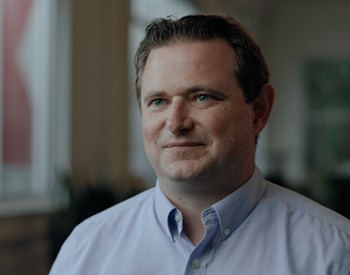
The Kodiak driver learns every single day. We take the data in, and we monitor what it does out in the field. We take those insights and apply them to the entire fleet so that with every Kodiak driver, AI improves in an incremental fashion.
Andreas Wendel, Chief Technology Officer, Kodiak
Verizon’s robust connectivity powers Kodiak’s Assisted Autonomy model
Recognizing that a strategic technology partnership was key to overcoming these challenges, Kodiak turned to Verizon. With deep expertise in connected and autonomous vehicle operations, Verizon understands the unique requirements that companies like Kodiak face when deploying next-generation transportation solutions.
Verizon developed customized 4G and 5G high-data-priority plans specifically for the needs of autonomous vehicle operations. The network delivers ultra-reliable, low-latency connectivity enabling near real-time communication between operations centers and trucks nationwide.
Priority traffic tiers ensure mission-critical communications receive network priority over regular consumer traffic, even when many people in an area are simultaneously using data. The network’s reliability supports constant data flow as vehicles upload sensor data, video feeds and operational information to enable remote assistance.
Kodiak’s IT team uses ThingSpace, Verizon’s centralized IoT platform, to manage the entire fleet from behind the scenes. "ThingSpace is by far the best," said Russell Adams, Kodiak’s Head of IT. "Our account knows about the kind of devices we’re going to provision, so I don’t have to manually supply that information. I just provide the SIM card ID, and the system accepts it."
Verizon ThingSpace enables Adams’ team to easily monitor, manage and troubleshoot connectivity, pulling detailed reports and analyzing network performance on demand. "Verizon simplifies my world. It helps a lot to not have to deal with multiple carriers," he added.
The platform streamlines complex fleet management tasks that would be nearly impossible to carry out by hand. Adams leverages Verizon’s robust ThingSpaces' API to develop custom applications that offer in-depth cost insights for key internal stakeholders, including the CTO and engineering team.
"I can get very customized reports that give me what I want to know about my fleet," he said. Verizon ThingSpace tracks data usage patterns across multiple SIM cards per truck, monitors connectivity status in real-time and provides cost transparency that helps the company efficiently scale its operations.

I would absolutely recommend working with Verizon.
Michael Wiesinger, Chief Operating Officer, Kodiak
Human-AI collaboration enhances safety and employee skills
With the right strategic partnership in place, Kodiak's ambitious vision has now become a reality. Multiple fully autonomous trucks now operate around the clock in challenging industrial environments, hauling frac sand without safety drivers in the cab. Verizon's extensive network coverage enables reliable connectivity even in these remote locations where traditional infrastructure is limited.
This modern network foundation allows Kodiak to deliver on its service model. "We have really done all the work, so we can hand over the trucks to them and provide the virtual driver as a service," said Wiesinger.
Remote fleet managers overseeing multi-state fleets can quickly intervene when vehicles encounter new, complex scenarios. This approach addresses industry-wide safety challenges by reducing human error and accelerating AI learning across the entire fleet, thereby enhancing oversight of safety-critical decisions. As a result, the company is also better able to meet its customers’ needs for autonomous operations.
With the right digital infrastructure in place, the company's Assisted Autonomy model is now strongly positioned to enable human-AI collaboration for its over-the-road trucking and industrial use cases at a commercial scale.
At the same time, Kodiak is demonstrating that autonomous technology can create more skilled careers while addressing the driver shortage. Traditional drivers transition into Assisted Autonomy operator roles, which demand higher technical skills and offer technology-enabled positions, while improving quality of life. Workers now utilize connectivity and fleet management tools to make data-driven optimization decisions, transitioning from physical drivers to remote fleet managers.
For Wiesinger, partnering with Verizon has created the reliable foundation that makes this transformation possible. "I would absolutely recommend working with Verizon," he said.
Scaling Kodiak's connectivity-enabled workforce transformation
Kodiak plans to scale its operations with enhanced Verizon connectivity supporting even larger, remotely managed fleets across multiple markets. Meanwhile, Kodiak continues to transform trucking careers by empowering more drivers to become fleet management specialists and AI oversight experts who utilize advanced connectivity tools for informed decision-making.
"The Kodiak driver learns every single day. We take the data in, and we monitor what it does out in the field," said Wendel. "We take those insights and apply them to the entire fleet so that with every Kodiak driver, AI improves in an incremental fashion."
The partnership with Verizon helps demonstrate connectivity-enabled approaches to the future of blue-collar transportation work, proving that autonomous technology creates opportunities for workers to develop advanced skills with growth potential rather than simply eliminating jobs.
As the autonomous trucking industry evolves, Kodiak and Verizon remain committed to demonstrating that human-AI collaboration, powered by reliable connectivity, can address labor shortages, improve safety and productivity—all while creating better professional opportunities.
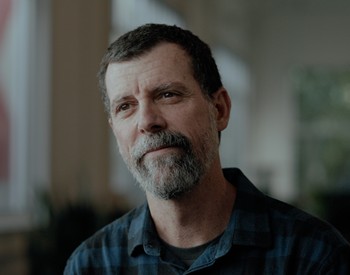
ThingSpace is by far the best. Our account knows about the kind of devices we're going to provision, so I don't have to manually supply that information. I just provide the SIM card ID, and the system accepts it.
Russell Adams, Head of IT, Kodiak
Learn more
Thingspace
See how ThingSpace gives organizations of all sizes all the tools to build IoT solutions or use end-to-end solutions to solve business problems.
Customer success story
Hear how Vay Technologies partners with the City of Las Vegas to bring innovative transportation solutions to residents and tourists.